
Building a house is not simply a matter of putting up walls using brick and mortar. In most cases, the walls embody dreams that have been nurtured over many years. That’s exactly why getting the blocks right and installing them properly matters more than it looks like on the surface.
This AAC block installation guide walks through the process in plain terms, from prepping the wall base to applying mortar, aligning blocks, and finishing off the masonry. It also gets into questions people actually ask AAC block price in Jammu, AAC blocks vs clay bricks, and how to pick the right AAC block mortar for the job.
The goal here is simple: help you understand what should actually happen on site, so you’re better equipped to have that conversation with your contractor and steer clear of mistakes that are completely avoidable.
Why Are AAC Blocks Unique?
Autoclaved Aerated Concrete (AAC) is a lightweight construction material consisting of a concrete-based mixture that has pores in its structure created during the manufacturing process. This is why an AAC block is lighter in weight when compared to traditional clay bricks.
When families start comparing AAC blocks vs clay bricks, weight is usually the first thing that jumps out at them. AAC blocks cut down the dead load on a structure and come in bigger sizes too, which tends to speed up wall construction quite a bit.
But the block itself is only one piece of the puzzle. Good results still come down to careful handling, accurate alignment, the right AAC block mortar, and workmanship that doesn’t cut corners.
AAC Block Installation Guide: It Starts With the Wall Base
A strong wall actually begins before the very first AAC block goes down.
The surface needs to be clean, stable, and properly prepped. Loose material, dust, standing water, uneven patches all of it should be sorted out before masonry even starts. Skip this step, and an uneven base can carry that problem straight through the entire wall.
A quick level check here can save a lot of correction work later on.
For a new home, this matters even more, because small alignment issues have a way of showing up later around door frames, windows, electrical points, and plastered surfaces right where you’d notice them the most.
How Should AAC Blocks Actually Be Installed?
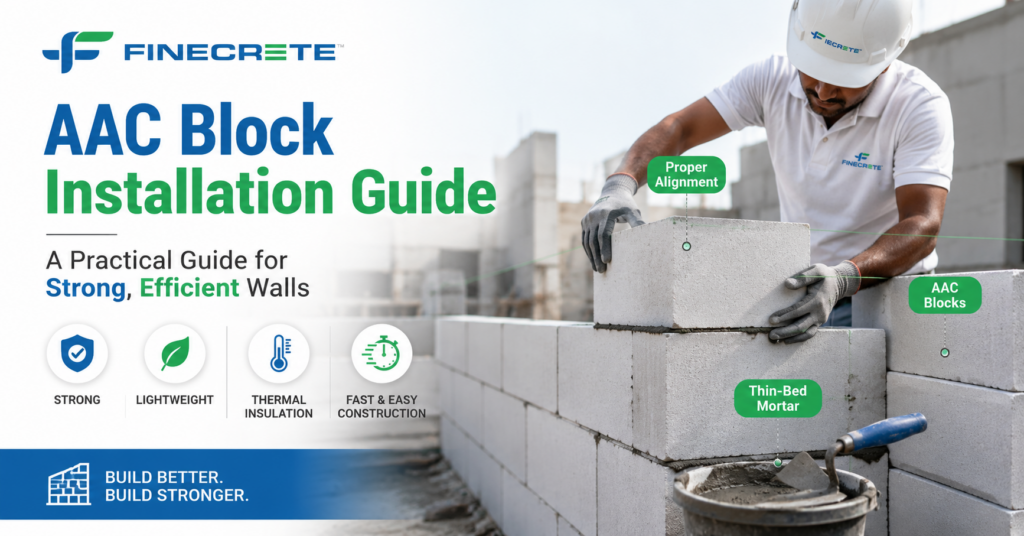
A typical installation runs through a fairly clear sequence: prep and level the base, mark the wall line accurately, prepare the recommended mortar or adhesive, lay the first course carefully, check horizontal and vertical alignment, then keep building up subsequent courses with proper jointing staggering the vertical joints along the way, checking level and plumb regularly, and giving the masonry enough time to settle before moving on to finishing work.
The first course deserves the most attention out of all of this. Get that row wrong, and later courses simply can’t fully correct it.
This is honestly one of the most important points in any AAC block installation guide worth reading: take your time on that first course instead of trying to patch up alignment problems after several rows are already up.
Choosing the Right AAC Block Mortar
The jointing material plays a bigger role than people expect in how the finished wall turns out. AAC masonry is generally built for thin joints, so using the right AAC block mortar or the manufacturer’s recommended adhesive actually matters here.
Mix the mortar according to the product instructions not by adding water until it “looks about right.” Too much water or too little both throw off application and consistency.
Blocks need to go in while the mortar’s still workable too. And piling on excessive mortar thickness just cancels out one of the real advantages AAC blocks offer in the first place their accuracy.
For bigger projects, it’s worth planning block supply and mortar supply together. A delay in either one leaves masonry workers standing around, and that has a way of dragging the whole schedule down with it.
AAC Blocks vs Clay Bricks: Which One Actually Wins?
There’s no single right answer here it depends on the building design, structural needs, local conditions, workmanship, and budget.
That said, a few practical differences are worth thinking through when comparing AAC blocks vs clay bricks. If you’re weighing this against red bricks specifically, it’s worth reading through AAC Blocks vs Red Bricks for a closer look at how the two actually compare on cost.
AAC blocks are lighter and generally bigger, which tends to make handling and installation easier. Their dimensional accuracy also supports thinner joints and more consistent masonry overall.
Clay bricks have been around for generations, and most construction workers already know exactly how to handle them. Their availability and long-established installation practices can make them the convenient choice in certain locations.
The real point is this don’t pick a material based only on purchase price. Factor in transportation, handling, mortar consumption, labour, how fast construction moves, and finishing requirements as part of the true wall cost.
What About AAC Block Price in Jammu?
If you’re researching AAC block price in Jammu, be careful about lining up one quoted rate directly against another it’s rarely an apples-to-apples comparison.
The final cost depends on block size, grade, quantity, transportation distance, delivery conditions, and how the supplier structures their pricing. A lower factory rate doesn’t automatically mean a lower delivered cost.
Picture two suppliers quoting different prices for the same project. One offers a slightly cheaper block rate but sits much farther from the site. The other charges a bit more per block but has a shorter delivery route.
Once you factor in truck charges, loading, unloading, breakage, and delivery time, that second option can easily end up being the more economical choice. This is exactly the kind of logistics puzzle covered in more depth in AAC Block Supplier in Gurgaon, which looks at why factory proximity matters so much for bulk orders specifically.
That’s exactly why AAC block price in Jammu needs to be judged as part of the landed project cost, not treated as some standalone number you compare in isolation.
Common Mistakes Worth Avoiding During AAC Block Installation
Even genuinely good blocks can end up performing poorly if the installation gets rushed.
A few mistakes that come up again and again: starting on an uneven base, ignoring vertical and horizontal alignment, using unsuitable or badly mixed mortar, making joints thicker than they need to be, failing to stagger vertical joints, handling blocks roughly and chipping them unnecessarily, skipping regular plumb checks as the wall goes up, and choosing blocks purely on price without checking any quality documentation.
A solid AAC block installation guide helps, but it can only take you so far skilled workmanship is still what actually makes the difference. Whoever’s installing the blocks needs to genuinely understand how AAC masonry behaves and follow what the manufacturer actually recommends.
How to Check AAC Blocks Before You Use Them
Before signing off on a large delivery, take a few minutes to actually look the blocks over.
Check for reasonably uniform dimensions, clean edges, and consistent appearance across the batch. If there’s excessive damage, inconsistent sizing, or anything that looks off, raise it with the supplier before installation starts, not after.
For bigger projects, it’s worth asking for the relevant quality and test documentation upfront.
This is where an experienced supplier genuinely makes construction less stressful. Someone who can explain the product, hand over supporting documentation, and help you understand what the installation actually requires gives the whole project team a lot more confidence going in.
Why Correct Installation Actually Matters for Your Home
For a family building a home, the wall isn’t just a construction component sitting on a checklist. It becomes part of the space where kids grow up, meals get shared, and everyday life just happens around it.
That’s exactly why saving a little time by rushing the masonry almost never turns out to be worth the risk.
Following a proper AAC block installation guide, picking suitable materials, and keeping workmanship consistent throughout all helps create cleaner, more stable masonry and cuts down on problems that would otherwise show up later in construction.
Finecrete focuses on supplying construction materials built for modern building needs, helping contractors and homeowners plan their masonry work with a lot more confidence. If you’re building in the hills, it’s also worth checking out the Affordable AAC Block Manufacturer in Dehradun for projects in that region specifically.
Frequently Asked Questions
1.What is the correct way to install AAC blocks?
Start with a clean, level base, mark the wall line accurately, use a suitable AAC mortar or adhesive, and carefully align every course as you go. Stagger the vertical joints properly, and keep checking level and plumb throughout the installation.
2.Is special mortar required for AAC blocks?
Yes, generally. AAC masonry is built for thin-joint application, so it needs an appropriate AAC block mortar or the recommended block adhesive. Stick to the manufacturer’s mixing and application instructions rather than improvising.
3.How should I compare AAC blocks vs clay bricks?
Look past the purchase price alone. Factor in block weight, size, transportation, labour, mortar consumption, how fast installation moves, finishing requirements, and how well the material actually suits your project.
4.What affects AAC block price in Jammu?
Block dimensions, quantity, quality or grade, transportation distance, delivery requirements, and supplier terms all play into it. Always ask for the delivered cost rather than comparing factory rates alone.
5.Can AAC blocks be used for residential construction?
Yes, AAC blocks are widely used for walls in residential and other building projects. Whether they suit your specific application comes down to the building design, structural requirements, applicable standards, and your project’s own specifications.
6.What should I check before buying AAC blocks?
Look at dimensions, overall block condition, consistency across the batch, supplier documentation, delivery terms, and whether the supplier can actually guide you on suitable mortar and installation practices. A sample inspection before placing a large order is worth the time too.
A Better Way to Plan Your AAC Masonry
The best construction decisions rarely come down to one number or one standout feature. A family planning a home needs to weigh quality, durability, installation, delivery, labour, and long-term value all together, not one at a time.
Use this AAC block installation guide as a practical starting point when talking through your project with your contractor and supplier. Ask questions before the material even reaches the site, inspect the blocks when they arrive, and make sure the installation team actually follows the recommended process instead of shortcutting it.
When the blocks, mortar, delivery, and workmanship all get planned together, what you end up with isn’t just a wall that goes up quickly. It’s a better-planned part of the home you’re building for the years ahead.