
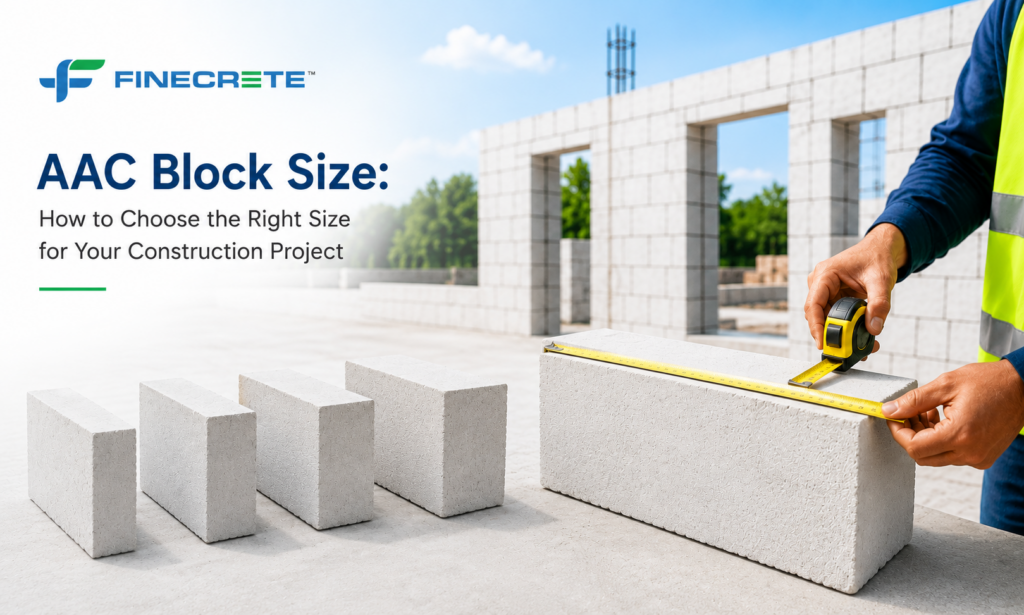
AAC block size seems like a minor detail when you’re planning a construction project, but it actually shapes how your walls get built, how many blocks you’ll need, and how smoothly work moves on site.
Picture this you’re building your family home. Foundation’s ready, columns are taking shape, and your contractor’s about to start masonry. You’re asked to approve the AAC blocks. At first it feels simple enough pick a block, check the price, place the order.
Then another question pops up: which AAC block size is actually right for this project?
Choosing purely on price can bite you later. The block needs to suit the wall, the construction plan, your transport arrangements, and how your workers will actually handle it on site. Get the choice right upfront, and masonry work goes a lot smoother while cutting down on wasted material.
This guide walks through what to check before ordering AAC blocks and how to actually make a practical call for your project.
Why AAC Block Size Matters in Construction
The size of an AAC block decides how much wall area a single block covers. Bigger blocks cover more ground with fewer units, while smaller sizes sometimes work better for certain wall layouts or specific applications.
And this ripples out further than just how many blocks you order.
Your AAC block size ends up influencing the number of blocks required for a wall, how easily workers can handle and move them on site, how long masonry and installation actually take, how much jointing material you’ll need, transportation and storage logistics, potential wastage, and the overall planning of the entire wall package.
Because of all that, it’s better to settle on block size together with your contractor or project professional, rather than grabbing whatever looks cheapest on a price list.
How to Choose the Right AAC Block Size
There’s no single size that’s perfect for every project out there.
The right pick depends on wall thickness, building design, application, and what your specific project actually needs. Before ordering anything, figure out exactly where the blocks are going.
An external wall, for instance, has different needs than an internal partition. And a residential build often calls for something different than a commercial one.
Get your contractor or engineer to confirm the required wall thickness and block specs first. Once that’s locked in, you can go to the supplier for the right product.
A good supplier should walk you through the available options not just hand you a price list and call it a day.
AAC Block Size and Wall Thickness: What’s the Connection?
Here’s something important to understand block dimensions need to be considered together, not in isolation.
A block has length, height, and thickness. Length and height determine how much wall area it covers, while thickness determines how thick your finished masonry wall actually is.
So don’t just ask a supplier “what’s your biggest AAC block?” Instead, give them your actual wall requirement and ask which dimensions actually fit.
This simple shift in how you ask the question can prevent a mismatch between the block you buy and the wall you’re actually trying to build.
For families managing construction for the first time, this alone makes the whole buying process a lot less confusing. Wall thickness also plays into acoustic performance if that’s a factor for you, it’s worth reading up on how Can AAC Blocks Be Used To Create Soundproof Walls before locking in your block spec.
Larger Blocks Can Change the Entire Masonry Process
A bigger AAC block size means each block covers more wall area on its own.
That can cut down the number of blocks workers need to place compared to smaller units, and it makes material planning easier since the team can estimate quantities based on total wall area.
But bigger doesn’t automatically mean better.
Workers still have to handle each block safely and place it accurately. The block still has to suit the wall design and whatever the project actually calls for.
So picking a size really comes down to balancing coverage, ease of handling, wall thickness, and the practical realities of your site.
How AAC Blocks Affect Material Planning
Once you know your wall area and the block dimensions you’ve settled on, you can estimate roughly how many blocks you’ll need.
But don’t just order based on a rough back-of-envelope number.
Construction sites have window and door openings, design changes that pop up mid-project, cutting requirements, and some unavoidable wastage. Transportation can eat into your usable quantity too, if blocks get damaged during handling or delivery.
There’s a useful lesson buried in Finecrete’s reference material here: the quoted material rate is rarely the same as your final cost. Freight, breakage, delivery delays all of it shapes what the project actually ends up costing.
So when you’re planning your AAC block size, plan the full material requirement and delivery schedule alongside it, not separately. It’s also worth planning the finishing layer at the same time this roundup of Top 5 Questions About Gypsum Plaster is a useful read once you’re ready to think past the blocks themselves.
AAC Block Size and Transportation
Here’s a situation a lot of project managers run into.
The quotation looks great. Order gets placed. Then trucks start showing up, and the real headaches begin.
If blocks are coming from a plant far away, transportation can eat up a significant chunk of your project cost. Longer journeys also tend to stretch out handling and delivery time.
That’s exactly why a supplier’s location matters when you’re buying blocks in bulk.
A nearby supplier can usually organise deliveries more efficiently, respond faster when you need extra material, and cut down on disruption from delayed shipments.
The reference material also points out something worth remembering the lowest factory-gate quote doesn’t necessarily give you the lowest landed wall cost once everything’s added up.
Choosing AAC Blocks Beyond Just Size
It’s easy to get so fixated on dimensions that you forget to actually check the product’s quality.
Before placing a large order, look at the whole specification, not just the numbers on the size chart.
Check the block dimensions to confirm delivered blocks actually match what was agreed. Check the density to make sure it fits your intended application. Look at quality consistency blocks should look and measure roughly the same across the whole batch. Ask for documentation relevant quality and test information from the supplier. Understand the transportation arrangement how the blocks will actually reach your site and whether delivery’s included in the quote. And for bigger projects, batch traceability makes tracking quality issues a lot easier down the line.
These checks matter a lot more than people expect when you’re ordering a large quantity for a family home or commercial project.
AAC Block Size and Installation Planning
Picking the right size is honestly only half the job. The blocks still need to go in correctly.
The first course deserves careful alignment, since mistakes there tend to carry through into every course built on top of it. Workers should keep checking the wall for level and vertical alignment as they go, not just at the end.
The right jointing material matters too, applied the way the manufacturer actually recommends. Once the blocks are up and it’s time to move into finishing, sourcing from an experienced tile adhesive manufacturer becomes just as important, since a mismatched adhesive at the tiling stage can undo a lot of the precision you built into the masonry itself.
When blocks, jointing material, delivery, and installation all get planned together, the whole masonry process becomes a lot easier to manage.
This matters even more on projects where several trades are working to a fixed schedule. A delivery delay leaves workers standing around waiting, and a shortage of blocks can throw off the entire sequence of work.
How to Compare AAC Block Suppliers
Say you’ve got two suppliers in front of you.
Supplier A quotes a lower rate but sits farther away and gives you limited detail about delivery. Supplier B quotes a bit more but hands over clear specs, batch information, quality documentation, and an actual organised delivery plan.
Which one’s actually cheaper?
You won’t really know until you work out the complete landed cost.
When comparing suppliers, look at product specifications, AAC block size, density, quantity, transportation, delivery schedule, quality documentation, how they handle replacing damaged material, and whether they offer related products too.
Finecrete’s reference content recommends asking about truck-load requirements, batch numbers, test reports, samples, and whether jointing mortar or adhesive can be supplied alongside the blocks themselves.
That kind of upfront preparation genuinely saves a lot of trouble later on.
AAC Blocks in Jaipur, Haryana and Other Locations
If you’re searching for AAC blocks in Jaipur, AAC blocks in Haryana, or an AAC block supplier in Jaipur, don’t compare suppliers purely on the advertised rate.
Your location affects transportation and delivery planning directly. A supplier might quote an attractive material rate and then become a lot less competitive once freight gets added in. If your project sits further west, it’s also worth checking options among AAC block manufacturers in Rajasthan, since regional proximity can shift the landed cost quite a bit in that direction too.
The same logic applies when you’re searching for AAC block manufacturers in India generally. Evaluate the manufacturer not just on product availability, but on quality consistency, documentation, delivery capability, and actual support.
For a project in Gurgaon, working with an experienced AAC block supplier in Gurgaon can make procurement and delivery a lot smoother, especially if your project needs repeated bulk dispatches over time.
A Simple Checklist Before You Order
Before signing off on your AAC block order, keep this handy: confirm the required wall thickness, pick the right AAC block size with your project professional, check density and product specs, calculate the approximate quantity needed, ask for the complete delivered quotation, confirm transportation and delivery timelines, inspect a sample before a large purchase where you can, ask for relevant quality documentation, confirm how damaged blocks get handled, and coordinate block delivery with your masonry schedule.
It takes a bit of extra time upfront, sure, but it heads off much bigger problems once material actually hits the site.
Frequently Asked Questions
1. What AAC block size is best for house construction?
There’s no single best size for every house. The right dimensions depend on wall thickness, design, application, and your project’s specific requirements. Get your engineer or contractor to confirm the spec before ordering.
2. Does AAC block size affect the total construction cost?
Yes. Block dimensions affect the number of blocks needed, handling, installation, transportation, and material planning overall. Look at the complete landed wall cost rather than just the block rate on its own.
3. Are larger AAC blocks always better?
Not necessarily. Larger blocks cover more wall area, sure, but the right choice still depends on the wall’s application, thickness, handling requirements, and project specs.
4. How do I choose an AAC block supplier in Jaipur?
Compare suppliers on product specifications, quality documentation, delivery capability, transportation cost, batch traceability, and overall landed cost not just the quoted material rate.
5. What should I check when buying AAC blocks in Haryana?
Check block dimensions, density, quality consistency, quantity, transportation arrangements, delivery schedule, and relevant product documentation before placing a bulk order.
6. How can I compare AAC block manufacturers in India?
Look past price. Compare product quality, specifications, manufacturing consistency, documentation, delivery capability, and whether the supplier can actually support your project’s material and scheduling needs.
Make the Right Choice Before the First Block Goes Up
Building a home is a major investment. Whether it’s your first family home or a bigger project you’re managing, small purchasing decisions have a way of affecting the work long after the order’s placed.
The right AAC block size should fit the wall, the application, and the construction plan. But size is only one piece of the decision. Quality, density, transportation, delivery, handling, and supplier reliability all matter just as much.
Whether you’re looking at AAC blocks in Jaipur, sourcing AAC blocks in Haryana, comparing AAC block manufacturers in India, or searching for an AAC block supplier in Gurgaon, take the time to compare the complete offering, not just the price tag.
A good block matters. A good supply plan matters just as much.
Get both right, and your masonry team spends less time waiting around, fixing mistakes, or dealing with avoidable material problems and more time actually building the walls that’ll become part of your family’s everyday life.