
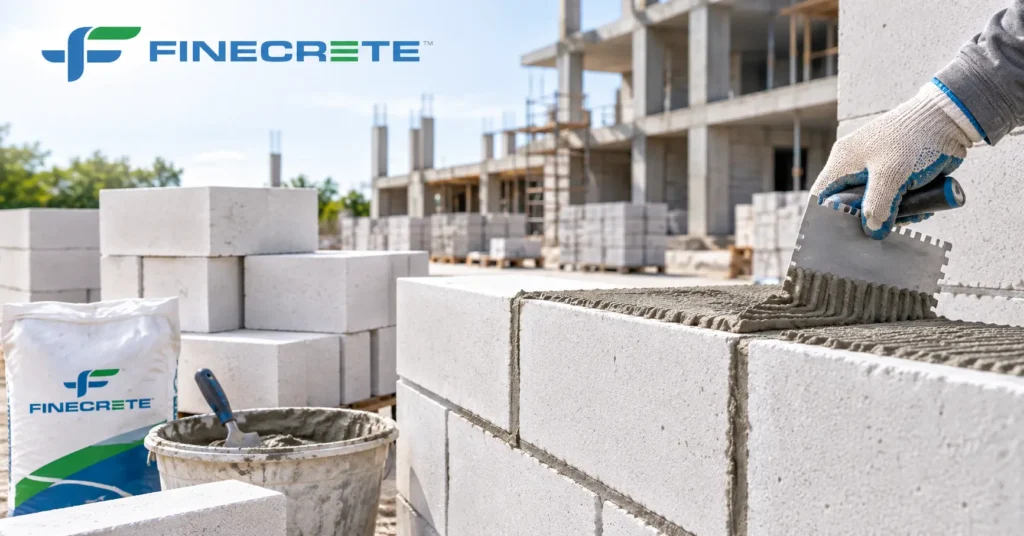
AAC block mortar might look like a minor detail in a bigger construction project, but it actually plays a big role in keeping AAC block walls properly joined, stable, and ready for whatever comes next. If you’re building your family home, managing a renovation, or running a larger project, picking the right bonding material genuinely makes the masonry process smoother and a lot more predictable.
Picture this your mason’s already started laying the first course of AAC blocks. The blocks themselves are lightweight and easy to handle, but they still need something proper going between each one. That’s where AAC block mortar comes in. It’s what creates a real bond between the blocks, while letting the masonry team keep a consistent joint as they go.
What Is AAC Block Mortar?
AAC block mortar is a specially formulated mortar built for joining AAC blocks during masonry work. It generally goes between adjoining blocks, creating a strong, consistent connection.
Unlike traditional masonry, where thicker mortar joints often get used, AAC block construction usually runs on a thinner jointing layer. This lets the blocks sit closer together and tends to give the wall surface a more uniform finish overall.
For a homeowner, the takeaway’s simple: the mortar isn’t just filler between blocks. It’s part of the whole wall system, not an afterthought.
How Does AAC Block Mortar Actually Work?
At its core, AAC block mortar connects one block to the next and builds out a continuous masonry wall.
Before applying it, the mason needs to make sure the block surfaces are clean and ready for laying. Then the mortar goes on following the product’s instructions, and the next block gets carefully positioned on top.
A solid masonry process really depends on three things: picking the right mortar, prepping the surface properly, and aligning each block carefully. Skip any one of these, and the finished wall probably won’t perform the way it’s supposed to.
That’s exactly why it’s worth talking through mortar requirements with your contractor before the AAC blocks even show up on site. If you’re sourcing blocks specifically for a project near Gurgaon, this piece on AAC Block Supplier in Gurgaon covers why factory proximity actually matters when you’re trying to coordinate mortar and block deliveries together.
Why Block Jointing Mortar Matters in AAC Construction
Working with AAC blocks, block jointing mortar is more than just a simple filler wedged between two masonry units. It’s what actually creates the connection holding individual blocks together.
Joint quality also shapes how smoothly the masonry work moves along. Get the blocks properly aligned and the mortar applied correctly, and the mason can keep building the wall course by course without random interruptions cropping up.
For a family building a home, this matters more than it sounds like it should, since construction already juggles a dozen moving parts. You’re coordinating labour, electrical, plumbing, materials, deliveries, payments a properly planned masonry system removes at least one source of confusion from that whole tangle.
AAC Block Jointing Mortar vs Traditional Cement Mortar
A question that comes up a lot: can regular cement mortar just be used for AAC block construction instead?
The answer really depends on the specific construction system, product specs, and what your project actually needs. AAC masonry often runs on a dedicated AAC block jointing mortar, built specifically around the characteristics of AAC blocks.
Traditional cement mortar and AAC-specific jointing products shouldn’t get treated as interchangeable without checking the manufacturer’s recommendations first. The main difference usually comes down to how the jointing system is designed to work with AAC blocks’ dimensions and surface characteristics.
Before buying, check product suitability (confirms it’s actually meant for AAC masonry), application instructions (helps the mason use it correctly), recommended joint thickness (keeps the masonry consistent), coverage (helps you estimate quantity), storage instructions (protects the product before use), and manufacturer guidance (helps match the material to your specific project).
Where Is AAC Block Mortar Used?
AAC block mortar mainly shows up in AAC block masonry, wherever individual blocks need proper joining to build walls.
It’s relevant across residential house construction, apartment projects, commercial buildings, partition walls, internal masonry, external masonry where the specified system allows it, and renovation or extension projects using AAC blocks.
The exact application should always follow the block and mortar manufacturer’s recommendations, along with whatever your project actually requires. For projects specifically based near Dehradun, it’s worth checking out an AAC Block Manufacturer in Dehradun who can coordinate blocks and mortar delivery together for that region. For bigger projects generally, planning the blocks and mortar together also simplifies procurement quite a bit instead of treating the bonding material as an afterthought, you can work out the expected requirement right alongside the block quantity.
How Much AAC Block Mortar Do You Actually Need?
The quantity required depends on several things wall area, block dimensions, joint thickness, application method, and the product’s coverage rate.
A simple way to plan it out: calculate the approximate wall area, confirm the AAC block size you’re using, check the recommended joint thickness, review the manufacturer’s coverage info, add a reasonable allowance for site conditions, and confirm the final quantity with your contractor or supplier before ordering.
Don’t estimate mortar purely by counting blocks. Two projects with a similar block count can still need very different amounts of mortar if their wall dimensions or application conditions differ.
What Should You Check Before Buying?
Grabbing the cheapest bag on the shelf isn’t always the safest way to plan your masonry material.
Ask your supplier about the product spec, recommended application, coverage, storage requirements, and compatibility with your specific AAC blocks. If you’re buying blocks in bulk, it also helps to coordinate mortar delivery with block delivery. The Finecrete reference approach highlights the real value of managing blocks, jointing mortar, and related materials together, so your construction sequence doesn’t grind to a halt just because one material’s missing.
For larger orders, keep this checklist handy: confirm the AAC block spec, check the mortar product details, ask about coverage, confirm the recommended joint thickness, check storage requirements, coordinate delivery dates, and keep the manufacturer’s application instructions on hand for the mason. Getting your quantity calculation right at this stage matters too this guide on AAC Block Adhesive Consumption walks through working out the numbers more precisely before you place a large order.
Why the Right Mortar Makes Construction Easier
Picture the day your masonry team actually starts work. Blocks are stacked at the site, the mason’s ready, and your construction schedule’s already built around that work happening.
Now picture finding out the required jointing material hasn’t shown up yet.
The blocks might be perfectly good, but the work still stops cold.
That’s exactly why AAC block mortar needs to be part of your material planning from day one. Good construction isn’t just about buying quality materials it’s about making sure those materials actually reach the site on time and get used correctly once they’re there.
A reliable supplier can help you plan the whole masonry requirement, from AAC blocks all the way through to the right jointing material. And once masonry’s done and you’re moving into finishing work, it’s also worth looking into the Best Granite Manufacturers in India for flooring and countertop needs down the line.
Frequently Asked Questions
1. What is AAC block mortar?
AAC block mortar is a masonry bonding material used to join AAC blocks during construction. It creates consistent joints between adjoining blocks when applied according to the product and project requirements.
2. Why is block jointing mortar used for AAC blocks?
Block jointing mortar creates a proper bond between AAC blocks. It’s part of the masonry system and helps blocks stay properly connected when applied and handled correctly.
3. Is AAC block jointing mortar different from traditional cement mortar?
They can differ in formulation, intended application, and recommended joint thickness. AAC-specific products are built for AAC masonry, so it’s better to follow the manufacturer’s recommendations rather than assume all mortars work interchangeably.
4. How do I calculate AAC block mortar requirements?
Start with the wall area, block dimensions, recommended joint thickness, and the manufacturer’s coverage information. Your contractor or supplier can then help confirm the actual quantity needed for your site conditions.
5. Where is AAC block mortar commonly used?
It shows up in AAC block masonry for residential, commercial, partition, and other construction applications wherever AAC blocks are specified. The exact application should follow your project’s specific requirements.
6. What should I check before buying AAC block mortar?
Check product suitability, coverage, application instructions, recommended joint thickness, storage requirements, and compatibility with the AAC blocks you’re using. Also plan delivery so the mortar actually arrives when masonry work begins.
7. Which mortar is used for AAC blocks?
AAC blocks require a factory-formulated thin-bed polymer-modified mortar, commonly known as AAC block jointing mortar or block adhesive.
8.How to make block jointing mortar?
To make and prepare block jointing mortar for construction, you mix dry pre-packed mortar powder with clean water in a ratio of about 3 to 4 parts powder to 1 part water (roughly 22% to 30% water by weight).
Build the Wall With the Right Material Plan
Choosing AAC blocks is really only one part of planning a good masonry system. The bonding material, application method, delivery schedule, and workmanship all matter just as much.
Whether you’re building your family home or managing a bigger construction project, take a bit of time to confirm the right AAC block mortar, understand how AAC block jointing mortar should actually be used, and plan the required quantity before masonry even begins.
The goal’s simple get the right material to the site, use it correctly, and keep construction moving without delays nobody planned for.