
Ask a few people who are building a house why they went with AAC blocks and they’ll have reasons ready: the price, the weight, a dealer who swore by them. Ask about the adhesive and you get a pause. Often it hasn’t been ordered. Or it gets ordered on the morning the mason is already waiting, because someone finally remembered.
I’ve seen that morning a few times. Blocks stacked, mason and helpers on site, everyone keen to get going. Someone asks where the adhesive is. Nobody knows. A few calls to the supplier, a round of chai, and the crew is still sitting there at lunch. You’ve paid a full day’s labour for very little brickwork. A single line on the material list would have fixed all of it.
What Is AAC Block Adhesive?
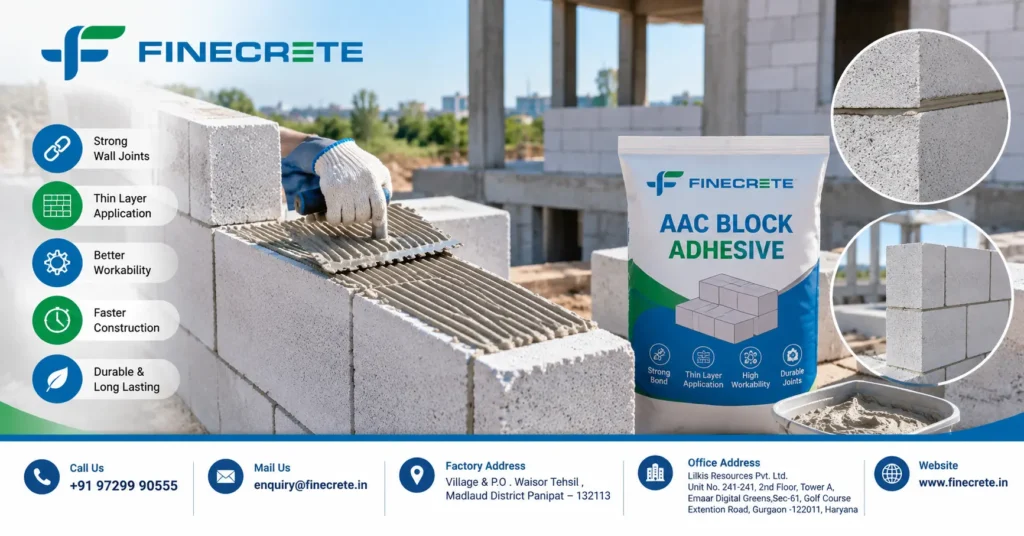
AAC block adhesive is a bonding material made for joining AAC blocks. The mason lays a thin bed of it on a course, presses the next block into it, and keeps going. A few hundred blocks later, you’ve got a wall.
These blocks are lighter and larger than bricks, and their surface takes the jointing material in its own way. Whatever the mason used on brick walls for years may not work well here. Ask the block manufacturer what they recommend and match it to your job. It’s best to choose the adhesive when you choose the blocks, since one depends on the other.
Why the Joint Matters
From a distance a wall looks like one solid thing. Up close it’s a lot of separate blocks, and the thin joints between them are what hold the whole lot together. A good joint keeps each block locked to the ones around it and makes it easier for the mason to hold his level as the courses go up.
The product can’t make up for careless work, though. Dusty blocks, too much water, a patchy layer, one block put in a little crooked: any of these will damage the joint, however good the bag was.
How to Apply AAC Block Adhesive, Step by Step
Brands differ, so read the bag first. Most of the time the process looks like this.
- Clean the block surface. Brush off dust and any loose bits. If adhesive goes onto dust, it bonds with the dust and not the block.
- Mix it properly. Use the water ratio printed on the bag. When the mix gets stiff, plenty of masons pour in a little extra water to make it easier to spread. It does spread easier, yes, but the joint ends up weaker. Don’t.
- Spread it evenly. Most manufacturers recommend a notched trowel. Aim for the same thickness across the full length of the block, not a heap at one end and a thin streak at the other.
- Place the block and check it. Set it down and check alignment against the blocks beside and below it before you move on. A slight error takes seconds to correct now. Spot it five courses higher and the blocks have to come down.
- Look over the joint. Check that it’s properly filled and the block hasn’t slipped. The plastering crew will also have an easier job with neat joints.
AAC Block Mortar vs AAC Block Adhesive
You’ll hear both words used on site, often for the same bag. Sometimes they do mean the same thing. Other times they don’t. Manufacturers name and formulate their products differently, which is why a “mortar” from one shop can behave quite unlike an “adhesive” from another. Here’s a guide to AAC block mortar if you want to understand how it works.
The label matters less than what the product is designed for. Does it suit the AAC blocks you’ve bought? Before paying, check:
- Product type: made for AAC block masonry
- Mixing method: water ratio and mixing steps
- Joint thickness: whatever the manufacturer specifies
- Coverage: how much area one bag does
- Application tool: how it’s meant to be spread
- Storage: it must stay dry
- Working time: how long the mix remains usable once prepared
Price shouldn’t decide it either. Paying a few rupees less per bag for something that doesn’t suit your blocks is a bad trade.
Where Block Jointing Mortar Is Used
Block jointing mortar is used on any job that uses AAC blocks: houses, apartment buildings, shops and offices, internal partition walls.
It also helps to plan around it. Rather than counting only blocks, work out blocks, jointing material, labour and delivery dates in one go. It matters more on large orders. Think of three trucks of blocks showing up and no jointing material with them. The crew has nothing to do and you’re paying them anyway. If you order both from the same supplier and have them come together, that doesn’t happen. For those buying near Delhi NCR, an AAC block manufacturer in Gurugram that supplies both is worth a call.
A bit of forward thinking helps here too. Flooring and wall tiling come after the walls, so it’s smarter to look through tile adhesive manufacturers while the masonry is still on than to go looking the day the tile crew turns up.
Mistakes People Make
Good products get spoiled by hurry more often than by anything else. These come up again and again:
- Spreading adhesive on dusty or dirty blocks
- Adding water without checking the instructions
- Laying joints thicker than needed
- Not checking alignment as the wall rises
- Mixing more than the crew can use before it sets
- Using something never meant for AAC blocks
- Starting the day without enough adhesive on site
- Not reading the manufacturer’s instructions
A site is a noisy place with deadlines and a dozen things going on, so these slips are easy to make. Taking two minutes to confirm the method costs a lot less than pulling down a wall and building it again.
How Much Adhesive Will You Need?
No standard figure covers every wall. The amount changes with wall area, block size, joint thickness, application method and the coverage the manufacturer states for that product. A rough way to work it out:
- Measure the approximate wall area.
- Confirm your block dimensions. Our AAC block size guide lists the common ones.
- Check the joint thickness the manufacturer recommends.
- Find the coverage figure for the product.
- Estimate the number of bags.
- Confirm the final quantity with your contractor or supplier.
Counting blocks won’t get you the answer by itself. Change the block size or the wall layout and the adhesive quantity changes with it.
Choosing the Right Product
Price per bag is only one part of the decision. Put these questions to the supplier: does it suit my blocks, what’s the coverage, how should it be stored, how long does the mix stay workable, and can you deliver when I need it?
For bulk orders, ask for the adhesive to be delivered with the blocks. A good supplier will help you time it so the masons aren’t left waiting. Building a house already means making a hundred decisions, and the wall material doesn’t need to become another one to worry about.
Frequently Asked Questions
1. What is AAC block adhesive?
It’s a bonding material used to join AAC blocks in masonry work. You apply it between the blocks following the manufacturer’s method.
2. How do you apply AAC block adhesive?
Clean the block surface, mix as the instructions say, spread it evenly with the recommended tool, set the block carefully, then check alignment and the joint.
3. Is AAC block mortar the same as AAC block adhesive?
Sometimes the two describe similar products, but formulations and recommendations vary between makers. Check the manufacturer’s specifications before treating them as interchangeable.
4. What is block jointing mortar used for?
It joins masonry blocks and gives consistent joints between them. For AAC walls, choose one that’s recommended specifically for your blocks.
5. How much adhesive do I need?
It depends on wall area, block size, joint thickness, application method and stated coverage. Work it out from real measurements and not from the block count.
6. What should I check before buying?
Whether it suits AAC blocks, and then its coverage, mixing instructions, recommended joint thickness, application method, storage needs and the manufacturer’s guidance.
Plan It Before the Blocks Arrive
Blocks make the wall, and adhesive holds it together. Choose the right product, follow the recommended application method, and sort out your block jointing mortar early. Then the crew keeps working and you don’t lose days waiting around.
The advice is the same for a small house and for a big project. Don’t leave the bonding material until the last minute. Order it with the blocks, find out what it needs, and show your mason how to use it.