
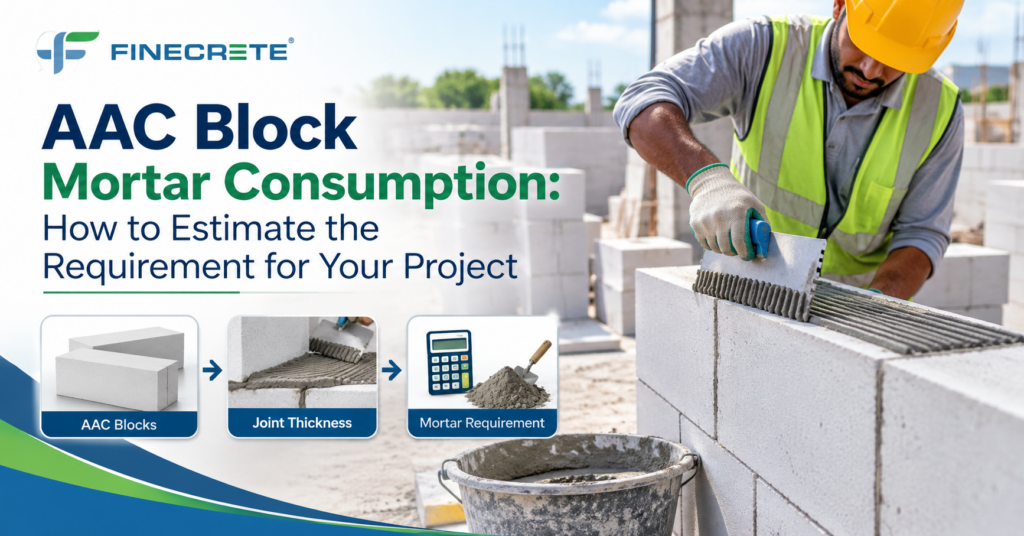
AAC block mortar consumption is something most people skip over until the bags run out halfway up the third floor. That is exactly what happened to Imran, a site supervisor on a small house job. He told the supplier “ten bags should do it” and left it at that. The top-floor walls had barely started when the last bag got opened. The masons stood around for most of a day, and the next delivery only turned up the following afternoon.
None of that was bad luck. He just never did the sum. It takes about ten minutes, and this post walks you through it. By the end you’ll know how to work out AAC block adhesive consumption for your own walls and order the right amount of AAC block adhesive, without sitting on extra bags or chasing a truck. At Finecrete, we hear a version of Imran’s story almost every month, so we’ve put the sum down in plain steps.
Why AAC Block Mortar Consumption Matters
AAC block mortar consumption is the quantity of joining material you need for each square meter of wall. With a thin 3 mm joint, most products land somewhere between 4 and 6 kg per square meter. Your exact number depends on block size, joint thickness and what the product’s data sheet says.
AAC walls don’t use thick beds of sand-cement mortar. They use a thin layer of block jointing mortar, a specialised masonry mortar for AAC blocks, so the amount per square meter looks small. Across a whole building, it isn’t. And a wrong guess hurts either way. Order too much and your cash sits in bags you may never open. Order too little and the masons stop. Leave bags in a damp store for a few months and they may not perform the way they should.
AAC Block Adhesive Consumption: A Simple Way to Work It Out
You only need four things: the wall area, the openings, the rate from the data sheet and the bag size. Then it goes like this:
- Multiply the wall length by the wall height, in meters.
- Take away the doors and windows. What’s left is your net wall area.
- Multiply that by the rate on the product data sheet. For a 3 mm joint it’s usually somewhere around 4 to 6 kg per square meter, but check the sheet, since products differ.
- Divide by the weight of one bag, then add 5 to 10 percent, because a little always gets wasted.
That’s the whole method for AAC block adhesive consumption. The rest is arithmetic.
Worked Example: AAC Block Mortar Consumption for One Floor
Say you have a wall 10 m long and 3 m high, with a door and a window that take up 4 m² between them.
- Gross wall area: 10 × 3 = 30 m²
- Net wall area after openings: 26 m²
- At 5 kg per m²: 130 kg
- With 10 percent extra: about 143 kg
- With 25 kg bags, that’s 5.7, so you order 6. With 40 kg bags, it’s 3.6, so you order 4.
Do the same for each wall thickness and each floor, then add up the totals. It’s a slightly boring ten minutes that saves a lot of grief later.
Working on a site with AAC blocks in Punjab? The sum doesn’t change. Only the block thickness and wall area on your drawing do.
What Can Change Your AAC Block Adhesive Consumption?
Two houses with the same wall area can still use different amounts. A few reasons why:
- Thicker blocks have a wider bed, so they take more per square meter
- Joints thicker than 3 mm eat adhesive fast, and AAC isn’t meant to be laid that way
- Uneven blocks need extra to fill the gaps
- A notched trowel spreads an even bed, while careless spreading wastes it
- Too much water in the mix, or bags stored on wet ground, cause losses too
Practical Tips for Ordering Block Jointing Mortar
Ask the maker for the data sheet and use their rate, not a rule of thumb from a friend. Check what the bag weighs before you calculate, because 25 kg and 40 kg bags are both common. Keep a buffer of 5 to 10 percent and stop there. Store bags off the floor, under cover. And keep your joints thin.
At Finecrete, we ask customers for two numbers first: the wall area and the block thickness. With those, a quantity estimate takes a few minutes. We get the same question from sites using AAC blocks in Haryana, and the answer follows the same steps.
Frequently Asked Questions
1.How do I calculate AAC block mortar consumption?
Work out the net wall area, multiply it by the product’s kg-per-square-meter rate, then divide by the bag weight. Add 5 to 10 percent on top for wastage.
2.What is the normal AAC block adhesive consumption per square meter?
For a 3 mm joint it’s commonly about 4 to 6 kg per square meter. Block thickness, joint thickness and the product itself can change it, so go by the data sheet.
3.How many bags of AAC block adhesive do I need for 1000 sq ft of wall?
1000 sq ft is about 93 m². At 5 kg per m² that’s roughly 465 kg, or around 19 bags of 25 kg. With a 10 percent buffer, think 21 bags. This is wall area, not floor area, so measure the walls.
4.Can I use cement mortar instead of block jointing mortar?
You can, but Finecrete wouldn’t recommend it. Cement mortar needs thick joints, which means more material, more weight on the wall and often weaker bonding. The proper joining material is made for thin joints on AAC.
5.Where can I get help estimating the quantity for my project?
Send your wall area, block size and number of floors to the Finecrete team, and we’ll help you work out a sensible figure before you place the order.
Final Thoughts
You don’t need special software for any of this. Measure the net wall area, use the rate from the data sheet, divide by the bag weight and keep a small buffer. That’s it. Treat AAC block adhesive the way you’d treat blocks and steel, as something you plan, not something you reorder in a panic. One estimate per floor means nothing is left to guesswork on site.
If you’re still weighing AAC Blocks vs Red Bricks, keep in mind that the mortar bill is very different too. If you’d like a second pair of eyes on your numbers, share your wall area and block thickness with Finecrete and we’ll go through them with you. Call Finecrete on +91 97299 90555 before your next delivery.