
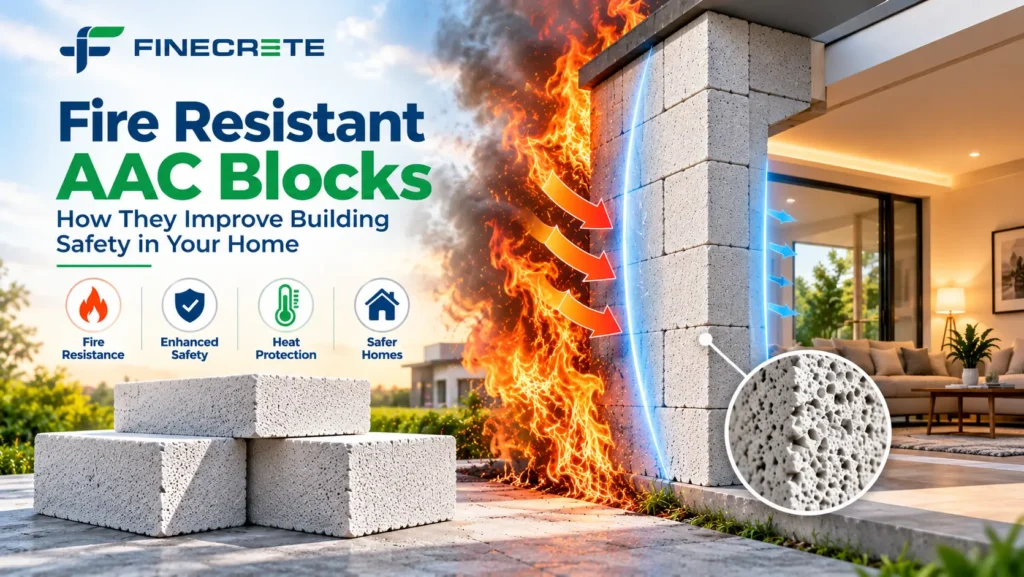
Fire resistant AAC blocks are not something most families think about until a scare makes them. Meena and Rajesh, a couple we’ll use as an example, were planning their first home with an open kitchen. Then a neighbour’s kitchen caught fire one winter evening. Nobody was hurt, but the smell of smoke stayed in their minds for weeks. “We kept asking ourselves what the walls would do,” Meena said. “Would they help us, or make it worse?”
That’s a fair question to ask before you pour a single slab. In this guide, you’ll learn what makes AAC walls safer, the main AAC block advantages and how to choose a reliable supplier. It’s all in plain words. At Finecrete, we hear these worries often, so we’ve kept the answers honest and simple.
What Makes Fire Resistant AAC Blocks Safer?
Fire resistant AAC blocks are made from non-combustible materials such as cement, lime, sand or fly ash, then cured in an autoclave. They don’t burn, they slow the spread of heat between rooms, and they give people more time to react. Wall thickness and plaster add extra protection.
Each block is full of tiny air pockets. Heat has a hard time passing through them, so a wall made of AAC can hold back flames and heat for longer than many people expect. That time matters. It can be the difference between getting everyone out calmly and a rushed escape.
One honest note: the real fire rating depends on the wall thickness, the plaster and how the wall is built. Ask any supplier for test reports before you rely on a number.
AAC Block Advantages Beyond Fire Safety
AAC block advantages include fire resistance, good thermal insulation, light weight, faster construction, sound reduction and lower environmental impact. The blocks are easy to cut and handle, which saves time on site. They work best for walls and partitions, not for heavy foundations.
Families usually mention these benefits first:
- Cooler rooms: the air pockets also slow heat, so rooms stay more comfortable in summer
- Lighter walls: less load on the structure, and easier to carry and lift
- Faster work: large, even blocks mean fewer joints and quicker walls
- Quieter homes: AAC helps cut down outside noise
- Greener choice: many blocks use fly ash, an industrial by-product
Among the other AAC block advantages is easy cutting, which makes it simpler to make space for pipes and wiring. There are limits too. AAC isn’t meant for heavy foundations, it needs careful handling and it works best with the right thin-bed mortar and plaster.
Where Fire Safety Matters Most in Your Home
You don’t have to worry about every wall equally. Think about where a fire is most likely to start, and where you’d want it held back:
- The kitchen: gas, hot oil and appliances make it the highest-risk room
- Electrical rooms and meter areas: wiring faults can spark
- Walls shared with neighbours: extra protection between flats
- Staircases and lift shafts: safe escape routes need to stay clear longer
At Finecrete, we suggest sitting down with your architect and marking these spots on the plan before you order blocks. Building in the north? Take a look at AAC blocks in Punjab to see what is available near you.
How to Choose an AAC Blocks Company You Can Trust
A good AAC blocks company shows you proof, not just promises. Before you buy, ask:
- Can I see test reports for the blocks, as per IS 2185 (Part 3)?
- Do you have a fire resistance test report for the wall thickness I plan to use?
- Does every consignment carry a batch number?
- Which strength grade and density are you supplying?
- Can you supply jointing mortar with the blocks?
- Can I see a sample before the bulk order?
A reliable AAC blocks company answers these directly, and in writing. Finecrete would rather you check twice now than worry later. Many buyers also like to get their wall finishing materials from a trusted Tile Adhesive Manufacturer in the same place, so the finish and the blocks work well together.
Build It Right: A Few Habits That Protect the Wall
- Use thin-bed jointing mortar, not thick sand-cement joints
- Handle blocks gently, since chipped corners weaken the wall
- Plaster the surface properly, because plaster adds protection
- Keep spare blocks dry and stacked off the ground
Not sure how much to order? Our guide to AAC Block Mortar Consumption shows you how to estimate it.
Frequently Asked Questions
1. Are fire resistant AAC blocks really safe for kitchens?
They are a good choice for kitchens, because AAC doesn’t burn and slows the spread of heat. The exact protection depends on wall thickness and plaster, so ask for test reports.
2. What are the main AAC block advantages?
Fire resistance, thermal insulation, light weight, quicker construction, sound reduction and lower environmental impact. They suit walls and partitions better than heavy structural parts.
3. How do I choose an AAC blocks company?
Look for test reports as per IS 2185 (Part 3), batch numbers on every lot, clear grade and density details and samples before you order. If your site is near the capital, compare what each AAC block manufacturer in Delhi can show you. You can also send your wall plan to Finecrete and we’ll help you pick the right block thickness.
4. Are AAC blocks waterproof?
They are moisture-resistant but not fully waterproof. Use proper plaster and waterproofing in wet areas.
5. Do AAC blocks need special mortar?
Yes. They work best with a thin-bed jointing mortar made for AAC. It gives stronger, thinner joints than ordinary sand-cement mortar. To estimate how many bags you need, read our guide on AAC Block Adhesive Consumption.
Final Thoughts
You don’t have to choose between safety, comfort and budget. Remember these points:
- Fire resistant AAC blocks add a real layer of protection, especially around kitchens and electrical areas
- AAC block advantages go beyond fire safety, from cooler rooms to faster building
- Always ask for test reports, batch numbers and samples from your supplier
Share your wall plan and block thickness with Finecrete, and we’ll help you choose the right block for each room. Call Finecrete on +91 97299 90555 before you place your order.