
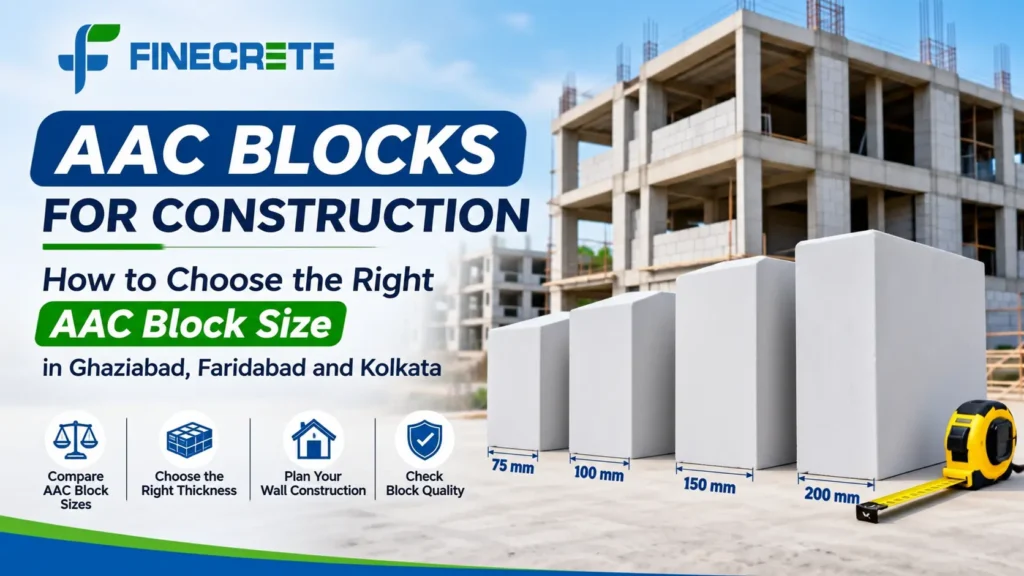
Ordering AAC blocks for construction seems simple. Pick a supplier, place the order, wait for the truck. Then the truck arrives and half the blocks are the wrong thickness.
That’s roughly what happened to Rohit, a made-up name for a mistake we hear about often. He was building a three-storey house in Ghaziabad and ordered on price alone. The outer-wall blocks came too thin. The partition blocks came too thick. His mason lost a week cutting and patching. Nobody was lazy, and nobody was careless. Nobody had told him to start with the size.
So that’s where we’ll start too. This guide covers what AAC blocks are, how to match AAC block size to each wall, what changes between Ghaziabad, Faridabad and Kolkata, and how to lay and plaster the walls so they last. At Finecrete we’ve tried to keep the words plain, the kind you could use on site with a mason.
What are AAC blocks, and how are they made?
AAC stands for autoclaved aerated concrete. An AAC block is a lightweight building block made from cement, lime, fly ash or sand, water and a little aluminium powder. The mix rises like dough in a mould, gets cut into blocks with wires, then is steam-cured under pressure in an autoclave. The tiny air pockets make the block light and good at slowing heat.
That last step, the autoclave, is what gives the block its strength and stability. You’ll hear AAC blocks called AAC bricks, AAC walls or autoclaved aerated concrete blocks. Same thing. CLC blocks are a cousin: they’re made with foam and cured without an autoclave, so they don’t behave the same way.
AAC block size: the common sizes and where each one fits
The size you pick decides how much you cut, how much you pay and how the wall performs. The most common AAC block size is about 600 mm long and 200 mm high. What changes is the thickness.
How to choose the right AAC block size
Sit down with your drawing and go wall by wall:
- List each wall type: outer wall, inner wall, partition, parapet.
- Note the thickness the drawing calls for.
- Count the doors and windows and take them off the wall area.
- Add a little extra for cuts and breakage.
- Ask the supplier to confirm the AAC block size in writing before you pay an advance.
For a rough quantity, a 600 × 200 mm block covers about 0.12 square metres. A 100 square foot wall (about 9.3 square metres) needs roughly 77 blocks before wastage. If you’re comparing rates too, our guide to an AAC Block Supplier in Jaipur shows how to turn a cubic metre rate into a price per piece.
AAC blocks in Ghaziabad: what builders should check
Most AAC blocks in Ghaziabad go into apartment buildings, builder floors and independent homes, jobs where speed and tidy walls count. A few things matter more than the rest:
- Delivery timing. Narrow lanes and traffic hold up trucks. Ask for realistic delivery windows, not hopeful ones.
- Thickness per wall. Confirm outer and inner wall sizes before you order.
- Breakage. Ask how the blocks are packed and unloaded.
- Heat. NCR summers are fierce, and AAC’s insulation helps keep rooms cooler.
If you’re ordering AAC blocks in Ghaziabad, ask for a sample first and get the delivery to your site confirmed in writing. Our team can tell you what’s possible for your location.
AAC blocks in Faridabad: nearby supply matters
With AAC blocks in Faridabad, how far the plant is from your site often decides what you really pay, because freight and breakage add up on every trip. Our team at Finecrete supplies AAC orders across the NCR belt, Faridabad included. The same questions apply wherever you build: ask for the landed price, the batch details and the test reports.
If your site is closer to Gurugram, have a look at our page on an AAC Block Manufacturer in Gurugram. For sites further north, we also have a page on an AAC block manufacturer in Punjab.
AAC block manufacturer in Kolkata: what changes in a humid, rainy city
Kolkata is a different game. Humidity is high, the monsoon is heavy, and in many parts of the city the soil is soft. So when you’re choosing an AAC block manufacturer in Kolkata, think about a few extra things.
Moisture comes first. AAC soaks up water, so plaster and paint matter much more here than in a dry climate. Weight is the second. Lighter walls put less load on the structure, which can help on soft soil, though your engineer should confirm that for your plot. On site, keep blocks off the ground and covered during the rains. And one small plus: AAC is inorganic, so termites don’t eat it, although they can still get at wooden fittings.
If you’re building near the coast or in a heavy-rainfall pocket, use a good external plaster, a water-repellent paint and a damp-proof layer at the plinth. Ask any AAC block manufacturer in Kolkata about local delivery and how they pack blocks for wet-season transport. To check supply and delivery to Kolkata, the Finecrete team can confirm what’s possible for your site.
Are AAC blocks strong, safe and good for earthquakes?
For most homes, yes, if they’re used correctly. These are the questions we hear most:
- Are AAC blocks load bearing? In most multi-storey buildings, AAC is infill inside an RCC frame. Load-bearing use is limited to low-rise buildings and needs an engineer’s design.
- Can AAC blocks be used for exterior walls? Yes, with proper plaster and a water-repellent finish.
- Are AAC blocks good for earthquakes? They’re lighter than brick, which reduces the force on the structure. The frame and the design still matter most.
- What about fire? AAC doesn’t burn. Our page on Fire Resistant AAC Blocks explains how thickness affects fire performance.
How AAC compares with red bricks, fly ash bricks and CLC
Red bricks are heavier, smaller and slower to lay. They’re cheaper per piece, but a wall needs more mortar, plaster and labour. Fly ash bricks are solid bricks made with fly ash, which is not the same as AAC, since AAC is aerated and much lighter. CLC blocks are foam-based and not autoclaved, so properties differ and you should compare test reports. AAC blocks are light, easy to cut and quick to lay, with good heat insulation, but they need the right adhesive and plaster.
Per piece, AAC costs more than a brick. One block, though, covers more wall. Savings on labour, mortar, plaster and structure can make the finished wall cheaper, though not always, so work out the cost per square foot of wall, not per piece.
Laying and plastering: mortar, adhesive and gypsum
How you lay the blocks matters as much as the blocks. In short:
- Level the base and lay the first course in cement mortar.
- Use thin-bed adhesive for the courses above, spread with a notched trowel.
- Stagger the joints, so the vertical joints don’t line up.
- Cut with a hand saw, and make channels with a chaser, not a hammer.
- Plaster after the wall has settled.
The blocks are cured at the factory, so don’t soak them. For jointing and plaster, see our page on Masonry Mortar for AAC Blocks. People often ask whether mortar and grout are the same. They’re not. Mortar bonds blocks together, while grout is a thinner, flowing mix used to fill gaps and tile joints.
For interior walls, many builders choose gypsum plaster for a smooth finish. Our page on gypsum plaster Manufacturers in India has more. Keep gypsum plaster for dry interior areas, though. On exterior walls, use a cement-based plaster with a suitable finish, because gypsum doesn’t cope with constant moisture.
A short checklist before you order AAC blocks for construction
- Confirm the AAC block size for every wall type.
- Ask for test reports and check them against IS 2185 (Part 3).
- Get a sample, then weigh it and inspect it.
- Confirm the right adhesive and plaster for your blocks.
- Ask how blocks are packed, delivered and unloaded.
- Get the price, taxes and delivery charges in writing.
- Speak to someone who has used the same blocks.
It also helps to know the difference between an organised dealer and a local shop. Organised sellers usually hand you written specifications and batch details. A local shop may be cheaper but offers little paperwork if something goes wrong. Judge both by what they can show you.
Why you can trust this guide
Finecrete was founded in 2013–14 and, according to our website, serves more than 500 clients. We make AAC blocks, gypsum plaster and adhesive, and we’re ISO registered. We wrote this from the questions builders and homeowners actually ask us, and where an answer depends on your design, climate or location, we’ve said so. This guide was last reviewed in November 2026. Please confirm specifications, prices and availability in writing before you order.
Frequently Asked Questions
Planning your wall package
Rohit did go back to his drawings in the end, listed his wall types and reordered the right sizes. He says that lost week taught him more than any brochure. If you’d like to skip it, tell us your wall plan, block sizes and schedule, and we’ll go through it with you. Call Finecrete on +91 97299 90555, or visit finecrete.in to get started.