
Every seller you call will say they’re a manufacturer. That’s the first problem with finding an AAC block supplier. Naveen, a contractor building a small apartment block, found it out the hard way. (Made-up name, very real notepad.) Three numbers, three pitches. “We are manufacturers.” “We are the biggest AAC blocks company in the city.” “We can supply any quantity.” Then the first truck arrived with mixed block sizes and two shades of grey, and nobody could tell him which plant the blocks came from.
This guide is for anyone holding a notepad like his. We’ll explain how a supplier differs from a manufacturer, how to check any AAC blocks company before you pay an advance, and what to plan for when the blocks arrive. At Finecrete we’ve kept the words plain, because you’ll be using them on a site, not in a boardroom.
What is the difference between an AAC block supplier and AAC block manufacturers?
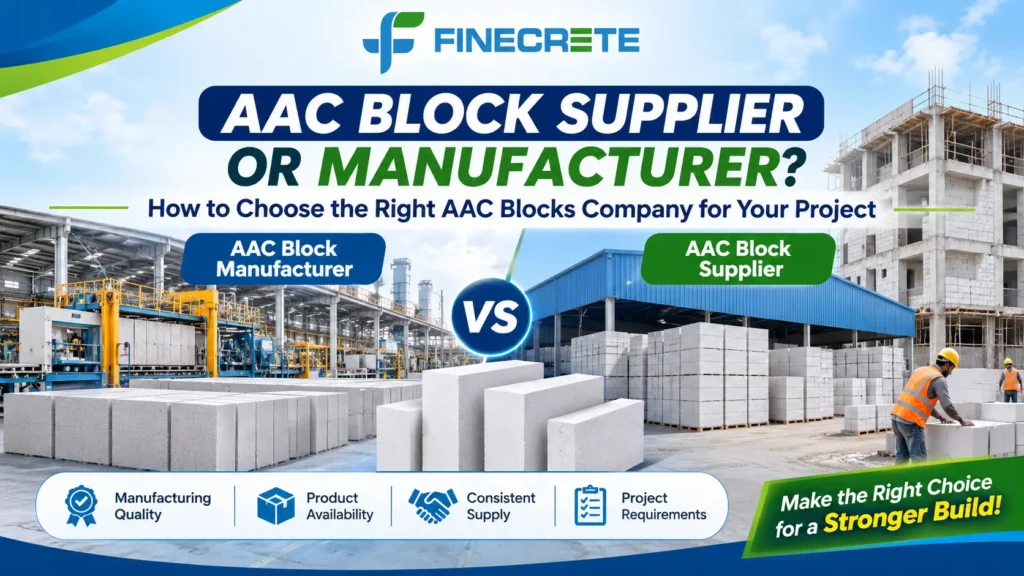
AAC block manufacturers make the blocks in their own plant. An AAC block supplier, also called a dealer or trader, buys from one or more plants and resells. Neither is automatically better. What matters is knowing which one you’re talking to, because that decides who answers for quality, batches and replacements.
The gap shows up in five places:
- Source. A manufacturer controls the raw materials, mixing, cutting and autoclaving.
- Traceability. A manufacturer can trace a block to its batch. A supplier may or may not manage it.
- Consistency. One plant’s blocks tend to match. Stock gathered from several plants often doesn’t.
- Support. A manufacturer answers technical questions directly.
- Reach. A good supplier can often deliver further, and in smaller quantities.
At Finecrete we make AAC blocks, gypsum plaster and adhesive, so we’re manufacturers, and you should weigh our opinion with that in mind. Plenty of dealers are honest. The one habit worth keeping: ask who made the block, and get the answer in writing.
How to choose AAC block manufacturers: questions to ask
When you speak to AAC block manufacturers, ask for the plant address and whether you can visit. A serious maker will say yes. Ask for recent test reports, too. In India, AAC blocks are covered by IS 2185 (Part 3), which the Bureau of Indian Standards lists as the specification for autoclaved cellular concrete blocks, so ask whether the blocks meet it.
Then get practical:
- Sizes. Which thicknesses do they make? Our AAC block size guide shows how to match thickness to each wall.
- Delivery. How are the blocks packed and moved? Breakage in transit quietly eats the budget.
- The whole system. Do they supply adhesive and plaster as well?
- After the sale. Who do you phone when the truck has gone? Ask for a name, not a general number.
A reliable manufacturer answers all of this without fuss. If the answers get vague, that tells you something.
What to check when buying from an AAC block supplier
A good AAC block supplier can be the right choice, especially for smaller orders or sites a long way from a plant. Before paying, find out which manufacturer the blocks come from, and ask for the name and batch. Check that the whole stock is from one lot, since mixed lots can differ in colour, size and strength, and ask to see test reports for that exact batch.
Then pin down the money. Is the quote a landed price, meaning blocks delivered to your site in one piece? And if a pack arrives broken, what happens? Get the replacement terms in writing. Our guide to choosing an AAC block supplier in Jaipur shows how to compare quotes fairly, and our page on AAC blocks in Kolkata covers what changes in a humid, rainy city.
What makes an AAC blocks company trustworthy?
Every AAC blocks company says it’s trustworthy, so ask what it can show you. Written specifications, not promises. Test reports and samples on request. References you can actually phone. Certifications you can verify. Straight answers on delivery and packing.
The warning signs are just as clear:
- a price far below every other quote
- no paperwork at all
- blocks that crumble or chip in your hand
- uneven sizes
- a seller who hurries you to pay
How to check AAC block quality on delivery
You don’t need a lab to catch the obvious problems. Blocks should look uniform in colour, without chalky patches, with clean, square edges. They should feel noticeably lighter than brick, and match the sizes you ordered, within a small tolerance. The supplier should be able to back the lot with strength and density reports, and our guide to AAC block compressive strength explains what those numbers mean.
AAC compared with red bricks
Is AAC better than red brick, or cheaper? Per piece, AAC usually costs more. But one block covers far more wall, so walls rise faster and need less mortar and plaster. AAC is also much lighter, which cuts the load on the structure, and its air pockets slow heat. Red bricks cost less per piece and every mason knows them, but walls take longer and have more joints. So don’t compare pieces. Compare the cost of a square foot of finished wall.
Are AAC blocks a sustainable building material?
Many builders call AAC sustainable. Many mixes use fly ash, a by-product of coal power plants, and India’s environment ministry has issued notifications on fly ash utilisation that encourage its use in products such as bricks and blocks. You can follow the timeline in a tribunal summary of the MoEFCC fly ash notifications. Lighter blocks also cost less to transport, and better insulation can trim cooling needs. “Sustainable” is a stretchy word, though, so ask what actually goes into the blocks you’re buying. Our page on Fire Resistant AAC Blocks covers the safety side.
Before you order: documents and plans to prepare
A good quote starts with good information. Before you contact any AAC blocks company, gather your wall plan with lengths, heights and openings, the thickness for each wall type, an estimated quantity with a little extra for cuts, your delivery address, a rough schedule, and your adhesive and plaster needs.
If your site is in the NCR or the north, see our pages on an AAC Block Manufacturer in Gurugram and an AAC block manufacturer in Punjab.
Laying and finishing: adhesive, mortar and plaster
The best blocks can still let you down if the wall is laid badly. Lay the first course in cement mortar to get a level base. Use thin-bed adhesive for the courses above, stagger the joints, and cut with a hand saw. Don’t soak the blocks. They’re already cured at the factory.
Our AAC block installation guide goes through it step by step. For joints, see our page on Masonry Mortar for AAC Blocks. For interior finishing, many builders choose gypsum plaster, and our page on gypsum plaster Manufacturers in India has more. One rule: gypsum plaster is for dry interior walls. Exterior walls need a cement-based plaster with a water-repellent finish.
Choosing a granite slabs supplier
Most homes need stone as well as walls, and the same care applies to a granite slabs supplier. Our team at Finecrete suggests asking:
- Can I see full slabs, not just small samples? Check for cracks and resin patches.
- Can I have slabs from the same lot, so colour and pattern match?
- What thickness and finish are available, and how are slabs packed for transport?
- Is the price in writing, including delivery?
For kitchens, darker and speckled granites tend to hide marks and stains better than pale ones, though the right colour depends on your cabinets and lighting. On bigger projects, granite is popular because it’s durable and comes in large slabs, so there are fewer joints. And when you compare any granite slabs supplier, ask what you’d ask an AAC block supplier: what exactly am I getting, how will it reach me, and who do I call if something’s wrong?
A short checklist before you order
- Get it in writing: who actually makes the blocks.
- Ask for test reports and check them against IS 2185 (Part 3).
- Take a sample. Weigh it, cut it, inspect it.
- Confirm block sizes for each wall type.
- Get the landed price, GST and delivery terms in writing.
- Ask how breakage and replacements are handled.
- Speak to someone who has used the same supplier.
Why you can trust this guide
Finecrete was founded in 2013–14 and, according to our website, serves more than 500 clients. We make AAC blocks, gypsum plaster and adhesive, and we’re ISO registered. We wrote this from the questions builders and homeowners ask us, and where an answer depends on your design or location, we’ve said so. This guide was last reviewed in November 2026. Please confirm specifications, prices and availability in writing before you order.
Frequently Asked Questions
Planning your wall package
In the end, Naveen asked each seller one simple question: which plant made these blocks, and can I see the batch report? Two of the three couldn’t answer. If you’d like help comparing yours, call Finecrete on +91 97299 90555, or visit finecrete. Tell us your wall plan, block sizes and location, and we’ll help you work out what you really need.